Coding with AI is great, and yet it has changed how I feel about my craft. As an experienced developer, I can write great prompts that generate the right code in the right place. I still get paid. The customer is happy. The sprint items are getting knocked out. At the end of the day, however, I don’t feel like the person I once was.
This shift to AI has affected me in terrible ways. There’s the abject horror I feel toward the end of the month when my precious tokens are running out. I can’t really bring myself to admit how much I’m using AI at work, so I could never ask my boss for more tokens. Instead I opt for cheaper agents. These cheaper agents often waste my time. I find myself swearing at them like Carmen Maroni from the movie “Johnny Dangerously”:
“You sneaky bastage! Don’t bullstein me, you somanumbatching icehole!”
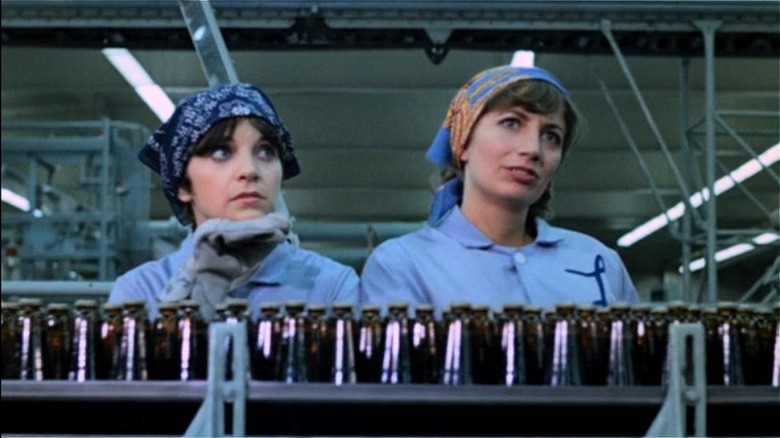
What I miss most is the craftsmanship. I’ve always equated coding to writing, as both require getting in a “flow” state to make progress. There’s no flow state in prompting AI all day. You prompt, turn your head to stare out the window, move your mouse randomly to stay “green”, then check the AI’s progress. All of a sudden, I’m freaking Laverne and Shirley watching the beer bottles zoom by at the factory.
I find myself unchallenged at work, but I’m addicted to agent-written code. I’m not sure “prompt-jockey” is how I want to finish a storied career. It doesn’t necessarily fit my lifelong goal of mastering a craft and creating something from nothing.
Who Am I?
When I was a kid, my dad worked with some legendary graphic designers. These men and women were artists before the age of computers, using pen and pencil to design some of the most memorable brand identities of our time. My dad was a copywriter, but here his job was motivating creatives to deliver client work faster.
I looked up to these creatives, not only because they gave me sheets of Helvetica Letraset dry-transfer sheets to play with. Their office was full of cool things my six-year-old brain couldn’t stop touching. X-Acto knives that were impossibly sharp, rulers that could draw a perfect circle, kneaded erasers that could be shaped at will, and oh the glue. Every kid I knew secretly sniffed rubbing cement. This was less of an office and more like a magician’s workshop.
These people were nothing like the grown-ups back in my sleepy suburban town. It wasn’t just the hair, the glasses, the clothes, the lifestyle, the cigarettes, the booze, the whole mystique. It was the confidence. They made things for a living. They got paid to be creative, and somehow that seemed like the coolest job in the world.
Sadly the dawn of the personal computer doomed the graphic design industry as people could now design a shitty logo in Microsoft Publisher using Comic Sans.
Being steeped in these creatives was a latent reason why my first career was in television. But that ended since there was no money in it and computers were the soup du jour. Cracking into IT is easy if you get a lobotomy and take a help-desk job. I was quickly promoted to something equally boring called system administration, but luckily it was there that I started to use code to solve problems. The rest is history, I guess, full of fun stories that you’re reading here!
Code became my paintbrush, features my canvases. I remember consulting for Smiths during a pre-sales meeting at a John Crane office in Skokie, Illinois. A handful of suits had flown in from London, gathered around a solid oak conference room table discussing costs in “pounds sterling”. I was the art-of-the-possible guy: bored, nervous, and very uncomfortable in my ass-kissing clothes.
Discussions came around to a user panel they needed, “Is it really going to cost $10,000?” It got me thinking, and I quietly opened my laptop. An hour later I had a working user panel querying real user properties, dressed in Smiths’ blue. I had created something from nothing with my hands and my head. The client was impressed, we sold the work, and I was proud.
I was a creative developer, chasing the same feeling those graphic designers were chasing. That’s what I wanted, that smooth and sexy feeling of success in a creative field of work. I held on to the mythos of those graphic designers I grew up with, and I believe they would be proud of what I’ve become.
Ramping Down The Dream
And now here we are in the age of AI. My development life has changed dramatically, away from feeling like an artist. Prompting a robot coder is not sexy. I’m not a “vibe coder”; instead I’m someone with decades of experience who knows exactly what he needs from AI. I’m no longer asking a junior developer to code up a feature and we preview, massage, and hone the code over a weeks-long timeline, like a theatre director and an actor in rehearsals. AI produces the feature in seconds, jumping straight to opening night.
I’m a little embarrassed by my day-to-day work streams now. Part of me wonders if the graphic designers from my youth would still recognize my work as creative at all? But now I understand why Laverne put Shirley’s glove on the bottle line at the Shotz Brewery. She was rebelling against the monotony of assembly line work. With AI doing more and more of the coding, I’m starting to worry that software development is becoming its own assembly line, and I’m just a development “operator” moving giant crates of code around with a forklift.
AI is making me feel less like an artist day by day. At this late stage, I don’t have the time or energy to reinvent myself professionally. I don’t want to trade my paintbrush for a prompt, I want to keep making code that feels like craft.
Meanwhile, my memories are something AI can’t recreate.